Both the British and the Axis Powers saw the strategic value of Malta to the war effort in 1941 and 1942, so while the Axis used its aircraft to try to take the island as part of its supply lines to Africa, the British were working to hold and supply the island and disrupt those lines, and Dick Davenport highlights those aircraft in his final post on the siege.
In February, 1941, General Erwin Rommel took command of the Wehrmacht Afrika Korps. Throughout 1941 and 1942 the “Desert Fox” forced the British further and further back, with the goal of seizing the Suez Canal. But his biggest challenge during this entire time was obtaining adequate supplies from Axis-controlled Europe.
For that, the islands of Malta stuck like a rock in the craw of the Axis, literally in the middle of supply lines from Italy to North Africa. Beginning in June, 1940, Italy’s Regia Aeronautica had tried to bomb Malta into submission. But the valiant Maltese continued to resist and inflict heavy losses on the Italians.
Once Britain realized Malta was strategically important, it had to supply the island with everything needed to not only continue the fight, but also to survive. Food, cooking and heating fuel, medical supplies all came by convoy. Anti-aircraft weapons and munitions were also essential. But the constant bombardment couldn’t be countered by three Gloster Sea Gladiators alone. That meant providing aircraft to challenge the bombers and escort fighters as they attacked.
Often the convoys to Malta included aircraft carriers loaded with Hurricanes and Spitfires. As the carrier got within about 300 miles of the island, the aircraft were launched with minimal ammunition and maximum fuel. Most, but not all, arrived at their destination to take up the fight.
Often, the Spitfires were Mk. Vc, fitted with tropical air filters. Image 1 is an Italeri 1/48th Spitfire Mk Vc, representing the aircraft flown by F/O Frank Jones, RAF, No. 249 Squadron.
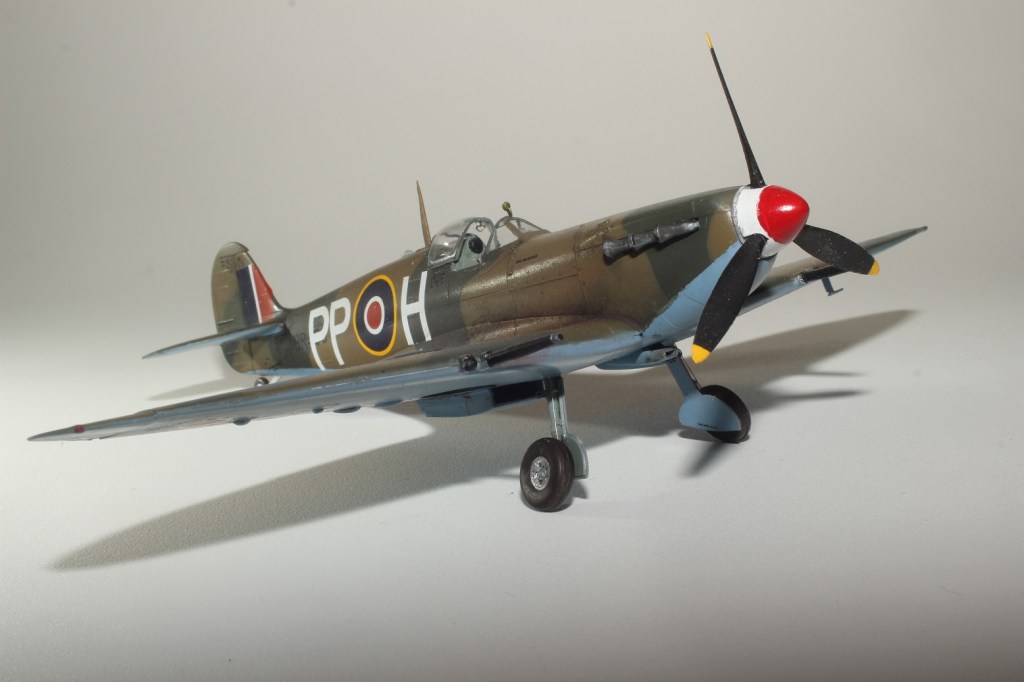
A Special Hobby Spitfire Mk.Vc represents the craft flown by Wing Commander Peter P. Hanks (BR498) while stationed at Luqa, Malta, in 1942. What makes this one interesting is that wing commanders were permitted to use their initials for aircraft designations, therefore the insignia PP-H.
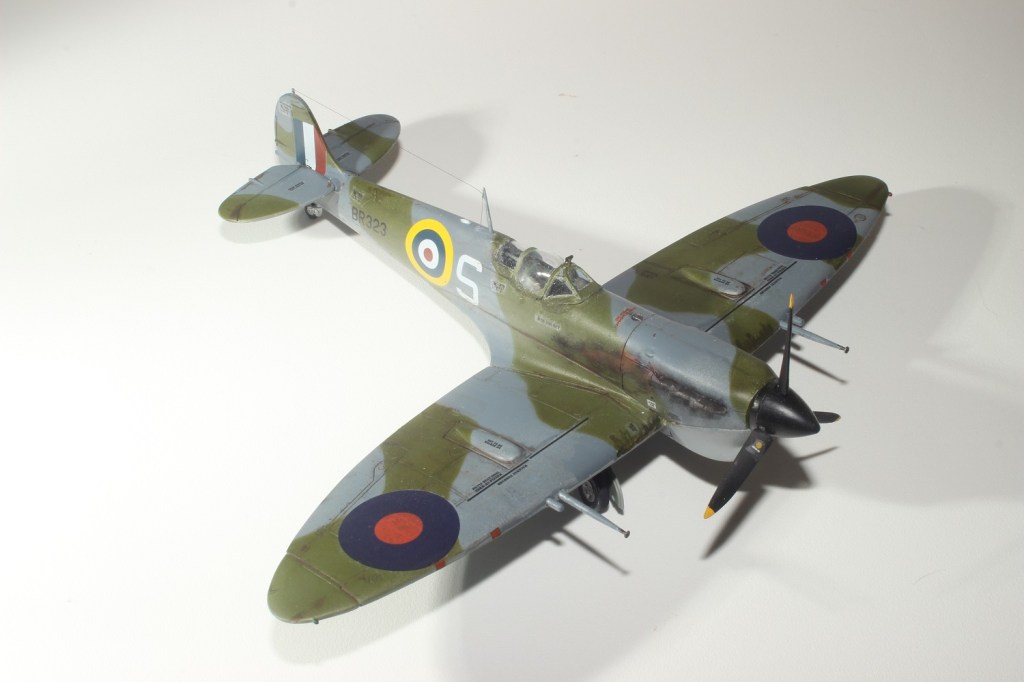
The Airfix 1/48th Spitfire Mk. Vc is a particularly interesting part of my display. It represents BR323/S of Sgt. George Beurling while stationed at RAF Luqua, Malta, July 1942. Beurling was a Canadian pilot serving in the RAF. He flew a Spitfire Mk. Vc from the aircraft carrier HMS Eagle to Malta on June 9, 1942, as part of RAF Squadron 249. Between then and the end of October, 1942, Beurling shot down 27 Axis aircraft, earning him the Distinguished Flying Medal with bar, Distinguished Flying Cross, Distinguished Service Order and the nickname “Falcon” or “Knight of Malta.” Beurling had several aircraft shot out from under him while at Malta, including BR323/S. To the public in Britain and Canada, he was known as “Buzz” Beurling; to his colleagues in Malta, he was known as “Screwball” Beurling. It’s worth learning more about his fascinating, and tragic, life: https://en.wikipedia.org/wiki/George_Beurling , https://www.historynet.com/screwball-beurling-the-falcon-of-malta/ and his autobiography, Malta spitfire; the story of a fighter pilot, by George F. Beurling and Leslie Roberts.

The Luftwaffe joined the Regia Aeronautica in attacking Malta when Fliegerkorps X arried in Sicily in January, 1941. Initially, Axis airpower dominated, with the Bf 109 E-7 flown by pilots experienced on the western front versus the Allies’ inferior Hawker Hurricanes flown by pilots with no combat experience. Eventually, as the Spitfire Mk V and more experienced pilots arrived, the tables turned. Men such as Wing Commander Peter P. Hanks and Sgt. George Beurling inflicted heavy losses on the Luftwaffe.
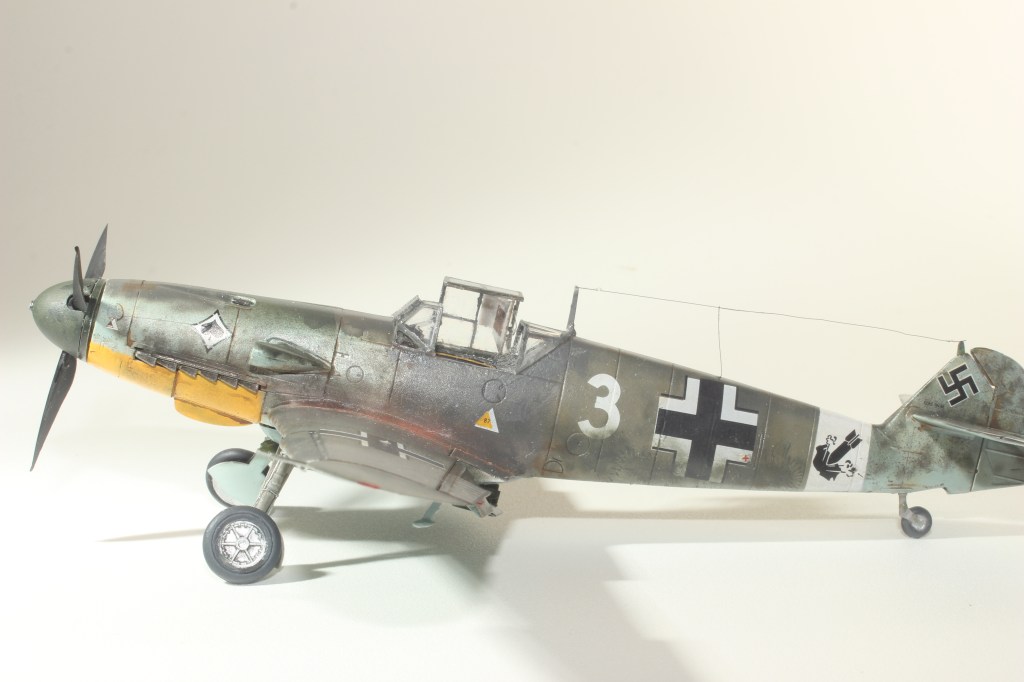
This 1/48th ICM Bf 109F-4/R6 built to represent Bf 109F-4/Z/B (Werknummer 7473), “White 3” of Uffz. Felix Sauer of 10. (Jabo)/JG53 “Pik As” at San Pietro, Sicily, March 1942. Formed in February 1942 to neutralize RAF airfields on Malta, 10. (Jabo)/JG 53 was the only Staffel of the Geschwader with its own emblem, a bomb striking Malta. On 27 March 1942, Uffz. Sauer belly-landed “White 3” on the beach near Pozzallo, Sicily.
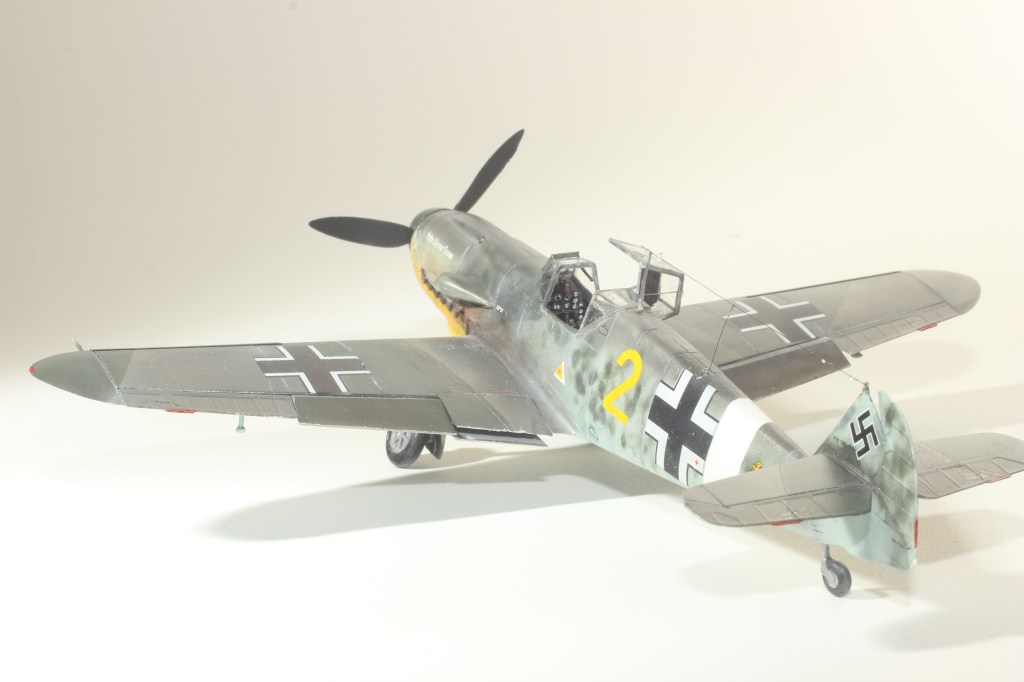
The 1/48th ICM Bf 109F-4/R6 represents Bf 109F-4/Z (Werknummer 13060), “Yellow 2” of Uffz. Karl-Heinz Witschke of 3./JG77 at Cosimo, Italy, in early July 1942. Uffz. Karl-Heinz Witschke was shot down by the famous Canadian ace George Beurling and crashed his “Yellow 2” in La Valletta, Malta on 29 July 1942.
In October 1942, the situation in North Africa required Luftwaffe air support for Rommel. In Europe, Operation Barbarrosa and efforts to reach the petroleum in the Balkans left the Luftwaffe spread too thin and experiencing heavy losses. The two-year seige of Malta was lifted. The last air raid over Malta occurred on 20 July 1943. It was the 3,340th alert since 11 June 1940.


 Capital Area Modelers Society
Leave a reply to boursawml Cancel reply