
By Norm Witte
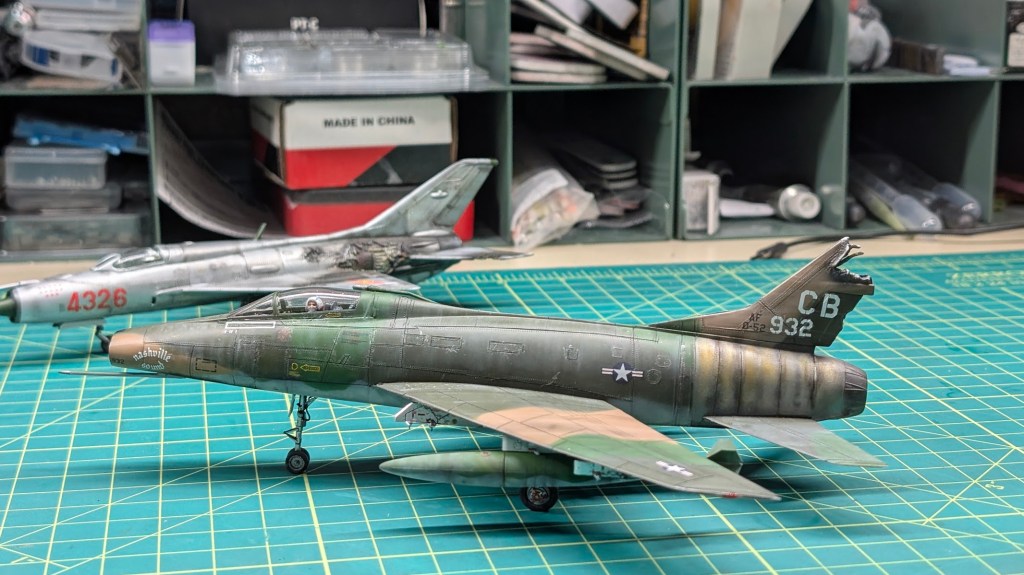
I’ve made a probably life-long commitment to build the Century Series Fighters—the F-100, F-101, F-102, F-104, F-105 and F-106—in 1/48 scale, which was kind of an outgrowth of completing the F-106. I’ve decided to do a better job on the F-105 than the F-106, and that includes scribing all the panel lines, since I’m starting with the Monogram kit I had in inventory. Long story short, I decided to buy a second, “practice”, model that was just supposed to be some plastic I was going to scrape on and then discard, but blossomed into a “why not finish it” build on its own. It started out as an out-of-the-box build, but, for reasons too complicated to explain, will now have some of the ResKit upgrades the “real” F-105 is getting. You will begin to see a pattern in my behavior emerging….
I have bought all of the 1/48 kits needed for my Century Series project, as well as an Eduard MiG-21. Two of them—the F-101 and F-102—are old Monogram kits that will need scribing, so I am determined to become skilled at this art, and I figure scribing five or six models should do it.
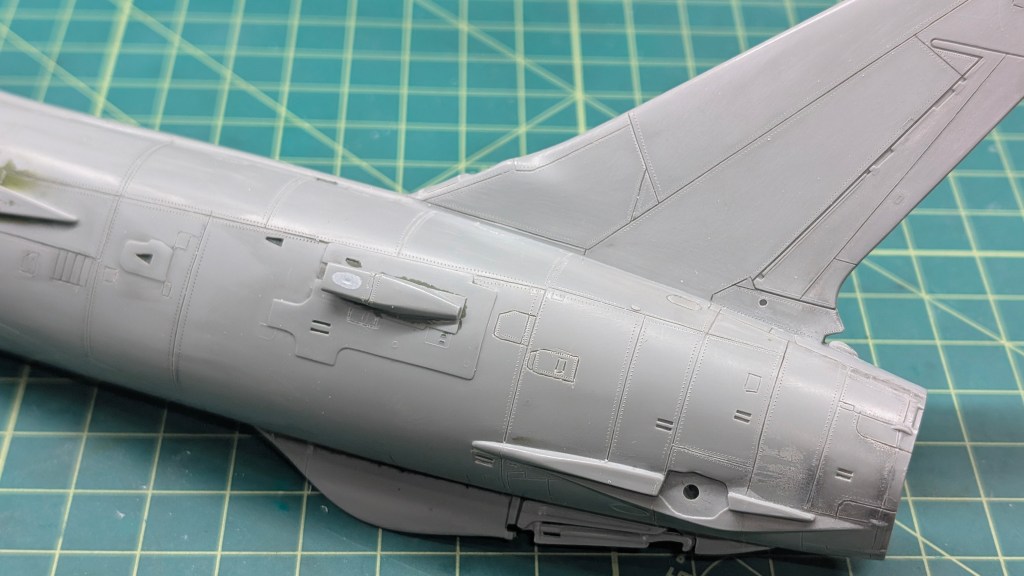
I’ve decided that I have to commit to at least 45 minutes of scribing a day.
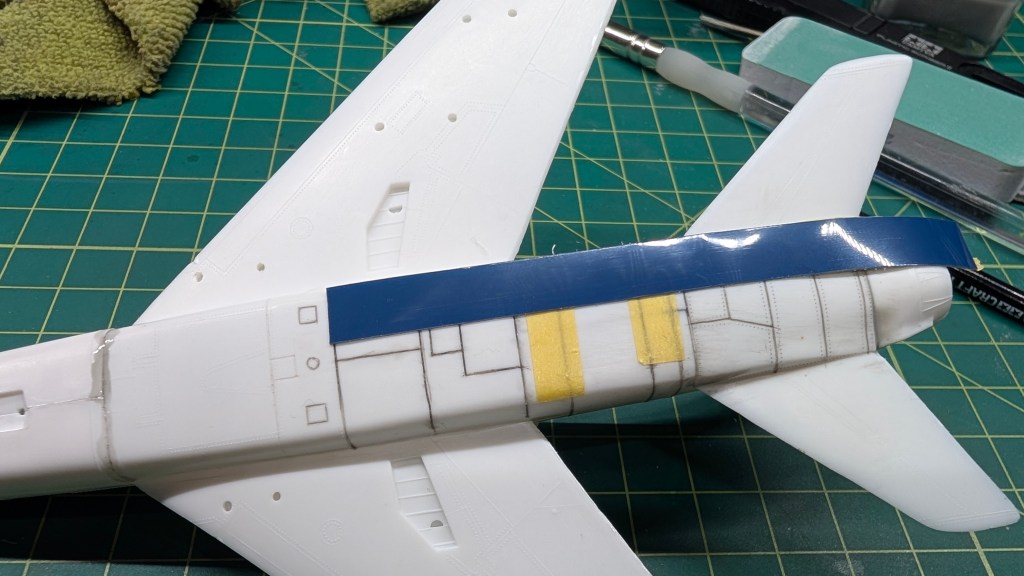
Having said all that, here’s what I have learned. First, my hands shake like crazy and I am terrible at free-hand scribing so I need a guide. For most purposes, the guide I’m liking most is Dymo labeler tape, though I also bought some specialty templates. The latest hack with that is to not apply the labeler tape directly to the model, but to instead put some Tamiya yellow tape on my mat first, then put the labeler tape on that, cut the masking tape around the labeler tape, and use the yellow tape as the adhesive. The yellow tape seems to hold its stickiness longer than the labeler tape, which means more re-uses before you have to get another chunk.
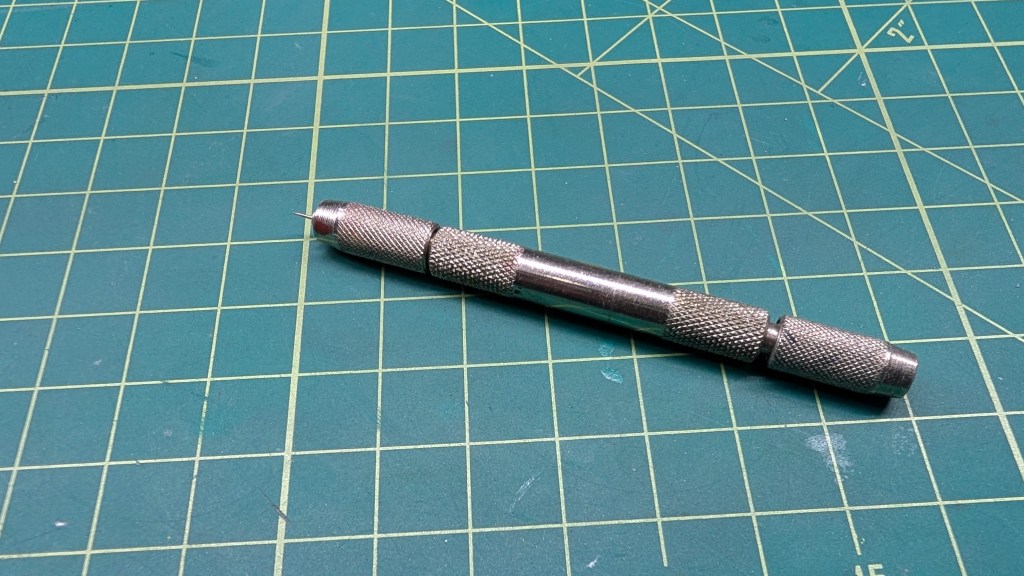
Having selected a guide, I needed a scribing tool. There’s a guy on Facebook (there’s always a guy on Facebook) who’s scribing every single tile and panel on a model of the space shuttle, and it’s mind-bendingly amazing (as the guy on Facebook always is). He said he was using a sewing needle chucked in a pin vice, so I decided to try that. It worked ok, but it kind of created V-shaped furrows rather than cutting plastic away.
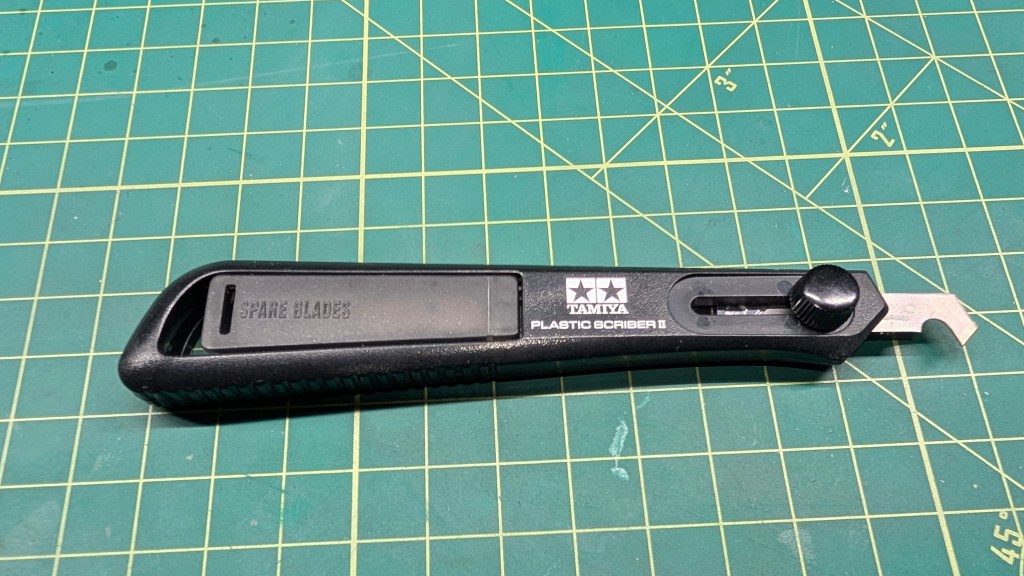
The next thing I tried wash the cheaper Tamiya scribing tool. This worked better, but had a tendency to “chatter” as I dragged it, and I didn’t like that.
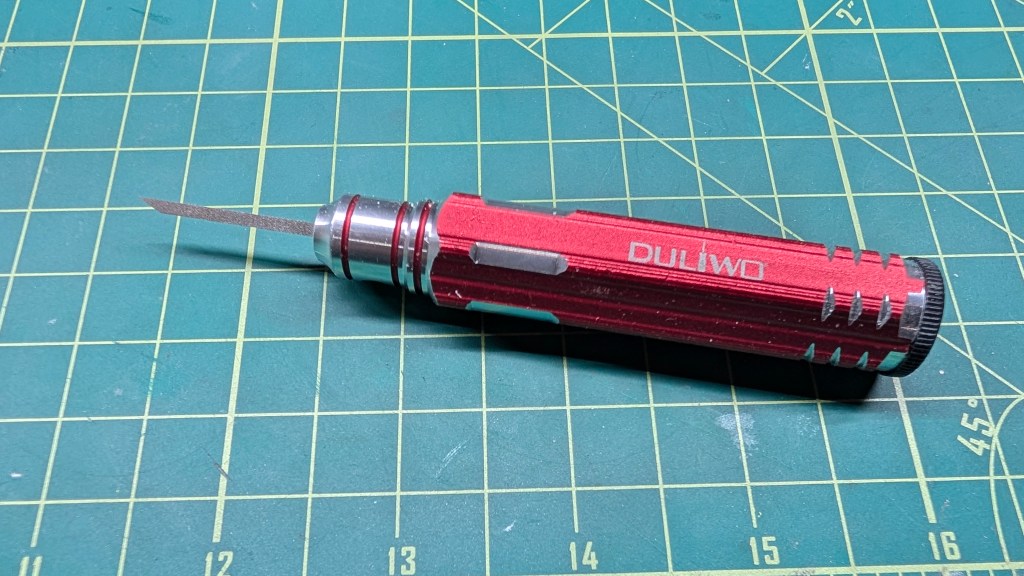
On to spending more money. I got a little red handle with a bunch of cutting tips, and that worked better than the pin vice needle and the Tamiya tool, but any sort of curve was really challenging.
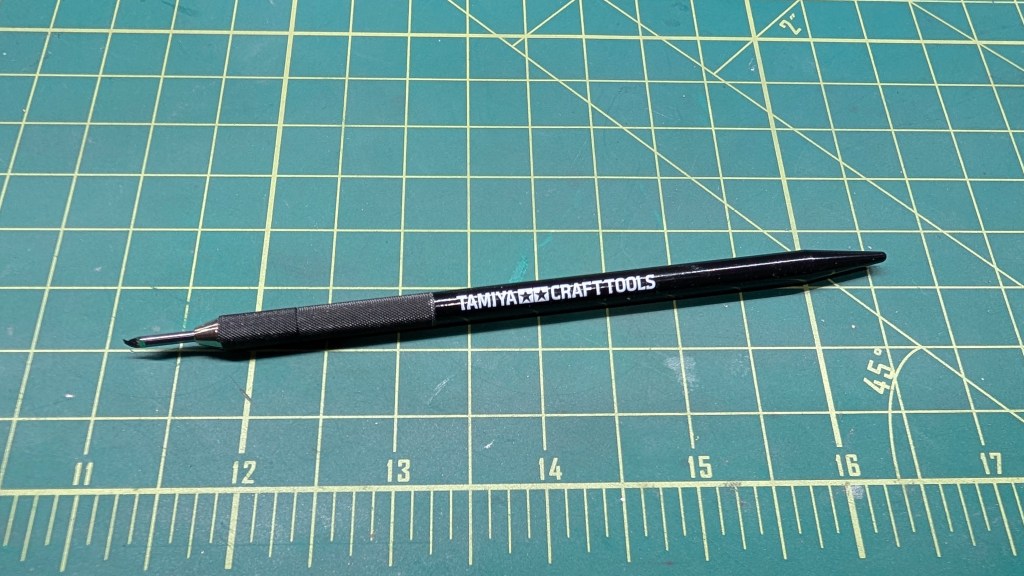
So I bought this expensive Tamiya handle and even more expensive blade, which is what I am using now, and I like it a lot. It cuts very cleanly and it does a nice job. I’m still not doing great with little circles, but that’s a challenge for another day.
My process now is to lay my tape down on the line I want to scribe. If it’s not going to be easy to see the start and end points, I’ll put a piece of yellow tape running perpendicular to the line at those points so that I can see them. Then I start scribing. The first pass is as light as I can do it. The second is about the same, and I gradually increase pressure until I’m getting a nice cut. I’m doing about eight passes, which probably leaves a trench that’s way too deep, but I’m still trying to sort out painting and I don’t want my seams to get buried under the paint. Once I am more comfortable with my priming, pre-shading, clear coating, decaling, clear coating again, washing and weathering technique, I might be able to scribe with a lighter hand. Walk before you can run, right?
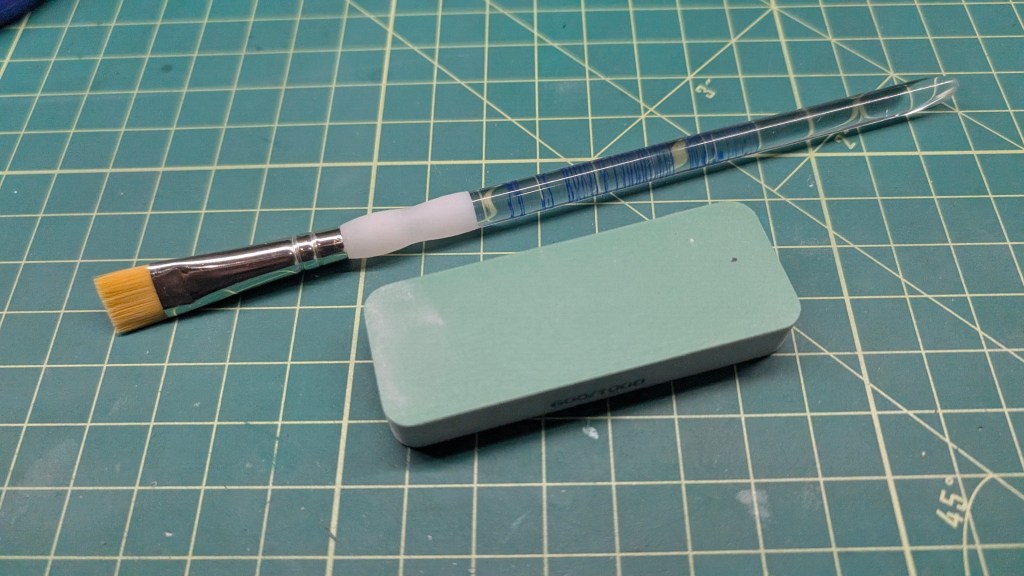
After I’m done scribing, I sand all the seams with a 600 grit sanding block until they are filled with white sanding dust. Then I clean the dust out, first using a microfiber towel, then a paint brush, and then the scribing tool for the most stubborn spots. After I’ve done that, I end up with a pretty smooth surface.
All of these techniques are evolving on the first F-105, so the quality of the scribing work on this model will vary quite a bit, and that’s just fine. I’m learning, and that was the point.
Also, while I was in Alabama on a sort of impromptu vacation, I got to visit the USS Alabama and see the second F-105B ever built. I also got to talk to the guy who’s restoring it. I was wearing my F-105 Century Series tee shirt at the time, so he could tell right away I was just an old geeky nerd.

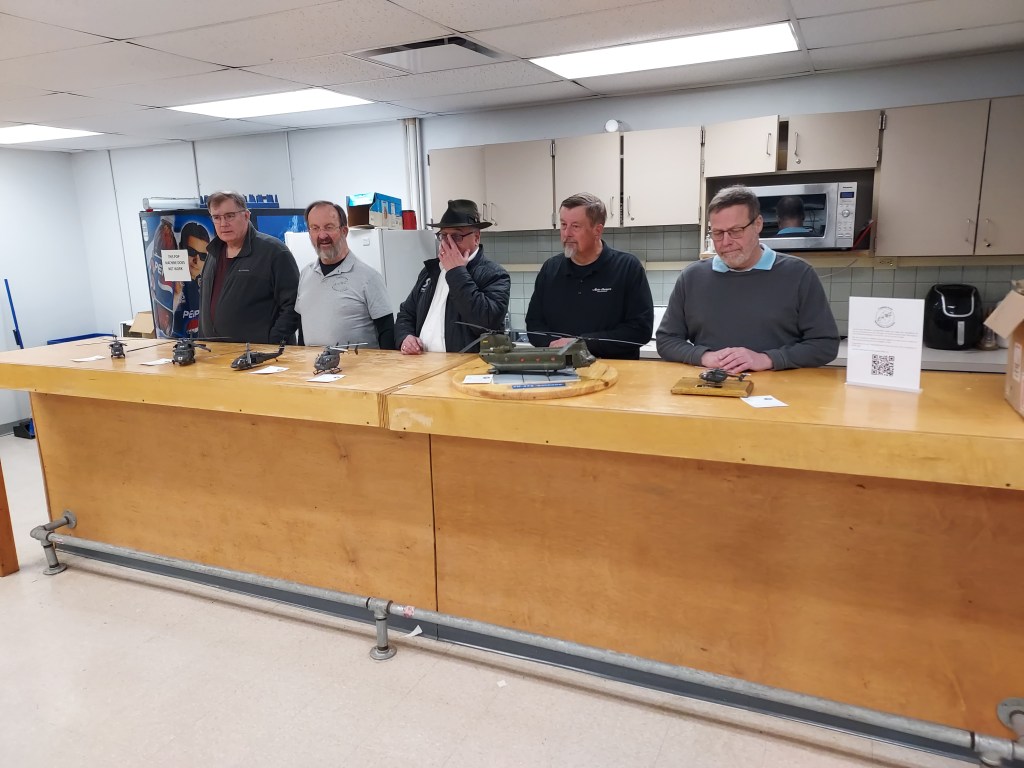

 Capital Area Modelers Society
Leave a comment