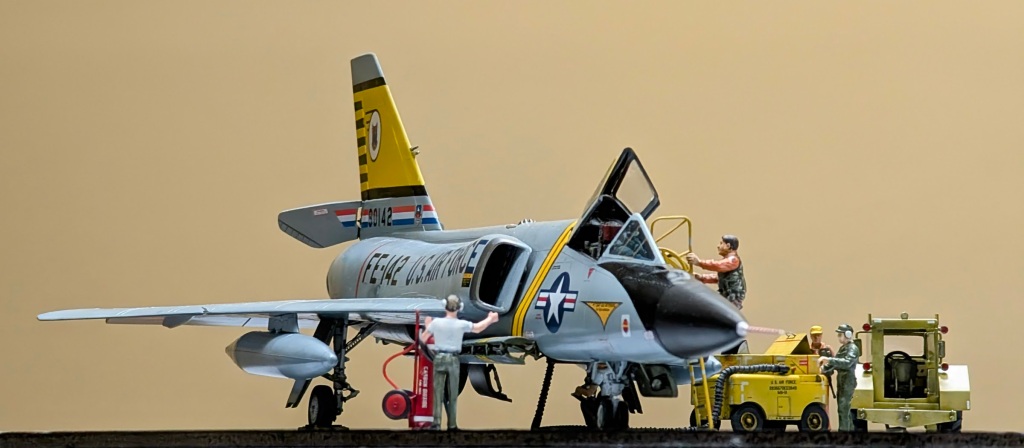
The late 1940s and early 1950s saw a frenetic burst in the U.S. to develop ever better jet powered fighters. The result was the post-Korean Century Series fighters, so called because of their designations in the F-1XX range:. the F-100 Super Sabre, the F-101 Voodoo, the F-102 Delta Dagger, the F-104 Starfighter, the F-105 Thunderchief, and the F-106 Delta Dart. I’ve set the ambitious goal of building all six of these planes in 1/48 scale, working backward from the F-106, which I’ve recently completed.
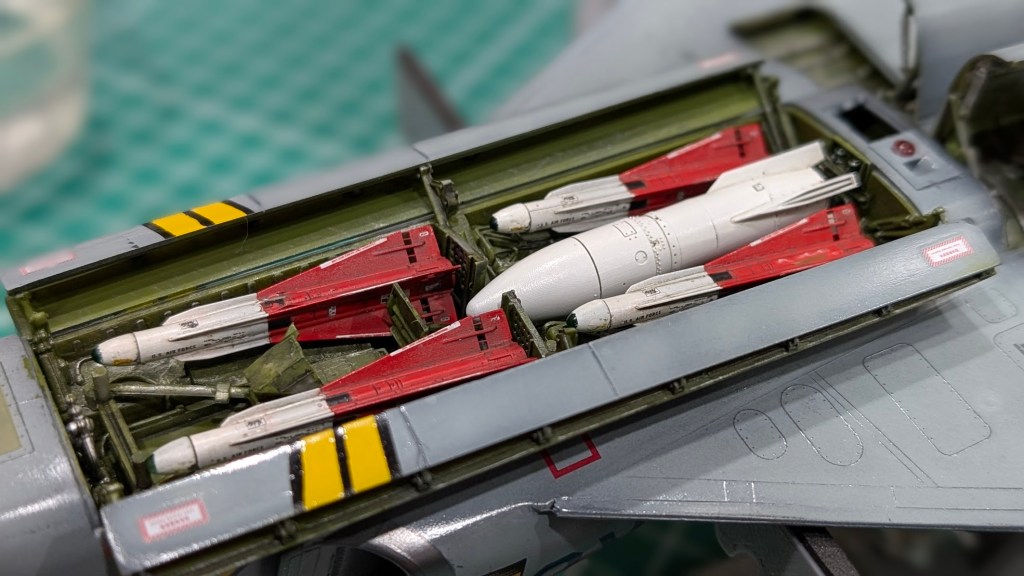
The F-106 (nicknamed “The Six”) was intended as an all-weather air superiority fighter for continental defense from Russian bombers. These supersonic fighters were equipped with AIM-4 Falcon missiles and, at times, the AIR-2 Genie rocket, an unguided 1.5 KT air-to-air nuclear rocket intended to take out formations of bombers. The aircraft was built around the Hughes MA-1 integrated fire-control system, which allowed the aircraft to be tied to the Semi-Automatic Ground Environment (SAGE). This enabled the aircraft to autonomously fly to its designated launch point after takeoff, launch its weapons and take appropriate evasive action before control was returned to the pilot to land the aircraft. At least, that was the plan.
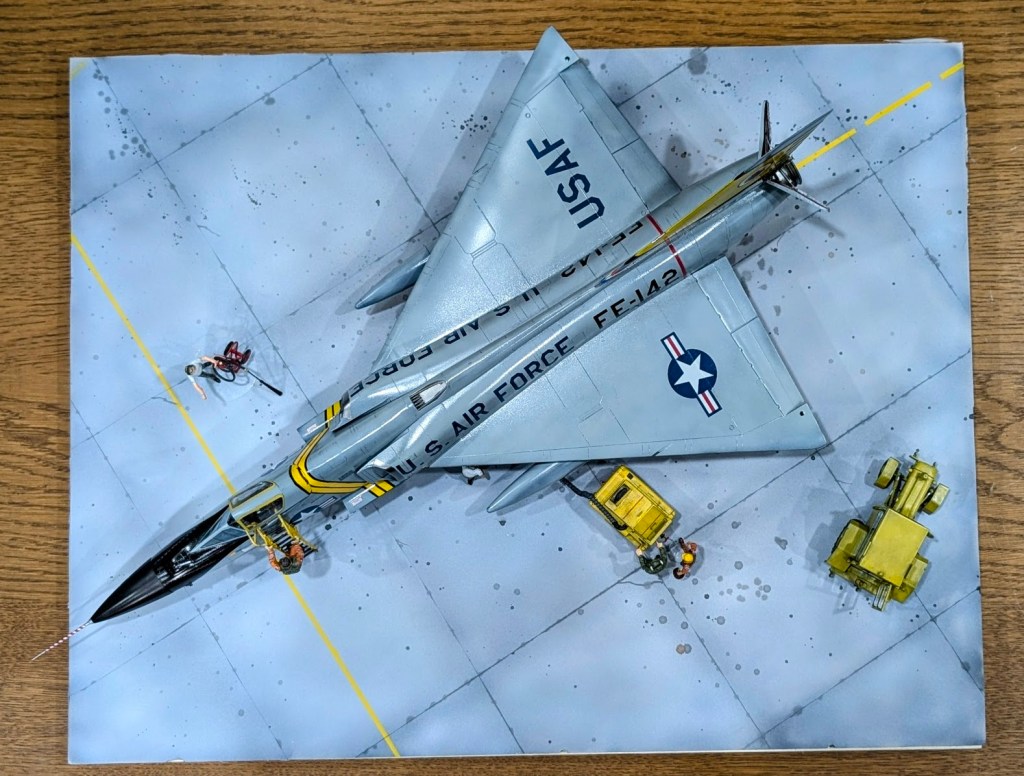
The F-106 never saw combat and only saw limited duty overseas. They were very fast, and the F-106 still holds the world speed record for a single engine aircraft. They were treated like exotic sports cars by their crews and were generally in immaculate polished condition.
I got back into modeling after a long hiatus a few years ago and decided to work on the Monogram F-106A 1/48 scale kit that I had purchased many years before. Over the course of this project, my skills have improved appreciably and I am proud to say that I believe I have progressed from a mediocre intermediate modeler to a semi-mediocre intermediate modeler. Because of that, the level of skill displayed in this model depends upon where in the build process I tackled a given step. But I am having a lot of fun, and that’s the important part.

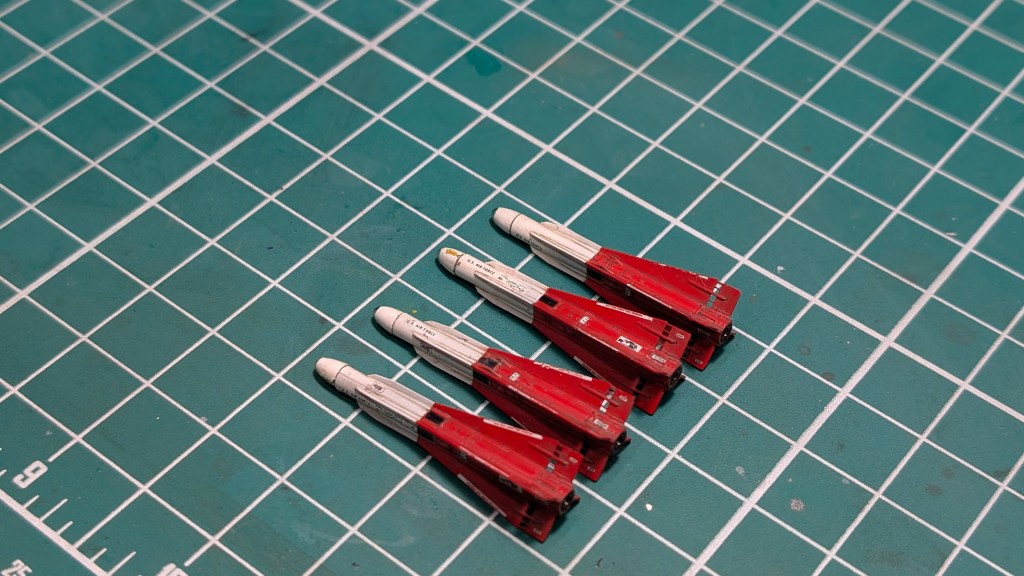
One of the problems I had with the kit was that somewhere along the line I lost the actuator for the speed brake, which was designed only to be displayed in the open position. I found that I could either buy an entire new kit on eBay (I didn’t think of contacting Revell to see if they would send me the part) or buying the ResKit 3D-printed speed brake upgrade for less money. I opted for the cheaper option, and that led to more purchases, like the ResKit 3D-printed Falcon missiles and Genie rocket, ResKit resin wheels and tires, and a real metal pitot tube.
This was the first time I tried black-basing a model with pre-shading. I painted the plane with Mr. Hobby gloss paint, though didn’t let much of the variation show through because these aircraft were so meticulously maintained. I chose to use the kit decals, but painted the black markings on the tail. Because I was concerned about color match, I also painted the stripes behind the cockpit.
The aftermarket weapons were awesome. They had far more detail than the kit parts and required a lot less assembly. I did have to section the Genie because it was too long for its place in the weapons bay. The Falcons came with more than 100 tiny decals. It was a tedious job, but worth it because I figured out how to do small decals, which will make stencil work on later models much easier. Of course, I can’t see the armaments at all because you have to be under the airplane to view them, and I’m too big. That’s ok.
I am also learning to do weathering with oil paints. I did very little of that on this plane because it’s supposed to be, you know, shiny.
When I finished the plane, I wasn’t really ready to just quit. I had several boxes of ground equipment and figures and I thought this might be a place to put them to good use. This led to building a tug and painting some little dudes, as I affectionately call my tiny plastic friends. I also got a resin start cart, resin fire extinguisher and an accursed boarding ladder that looked deceptively simple but has individually-molded ladder rungs. Mr. Ten Thumbs struggled with that one.
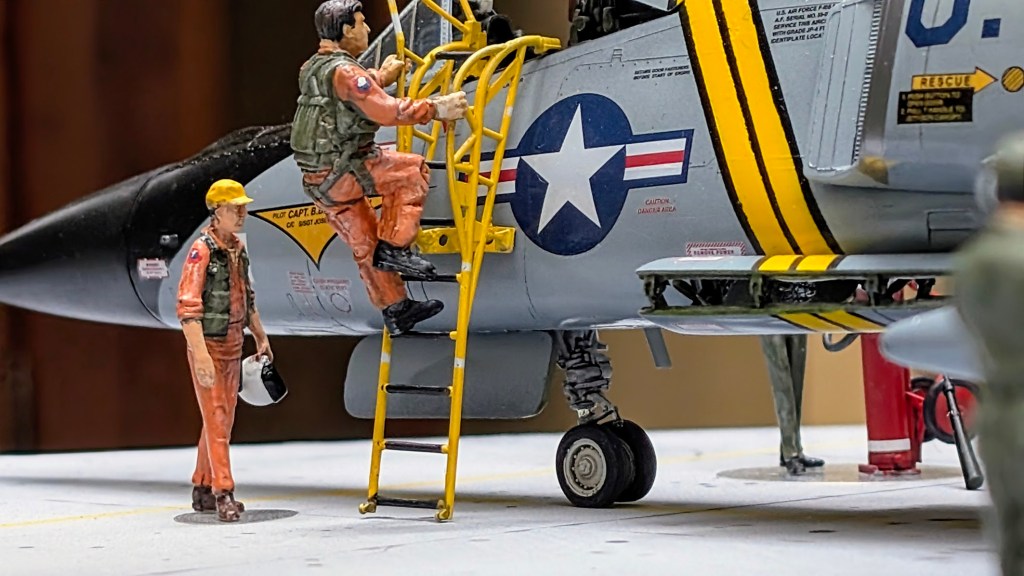
I made a base of some plywood bought from Hobby Lobby and some foam core we had on hand. I spent a little time scribing lines separating slabs and painting and weathering the base. I’m pleased with the outcome.
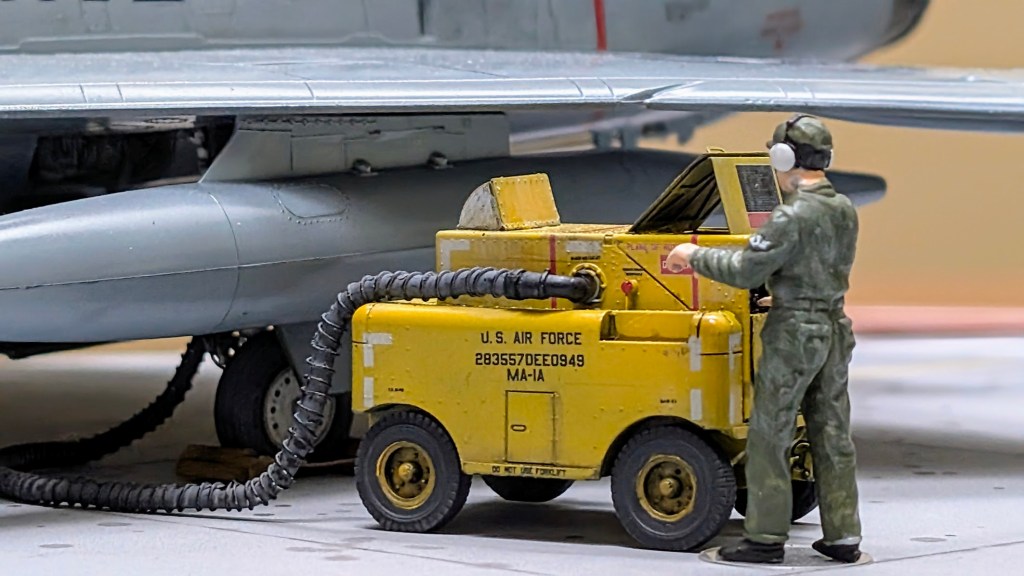
Of course, all the flaws leap out at me, but I am happy with my Six. With effort, I hope to become an intermittently proficient semi-intermediate modeler in the not-too-distant future.
Now on to the F-105. It’s Thud time!

 Capital Area Modelers Society
Leave a comment