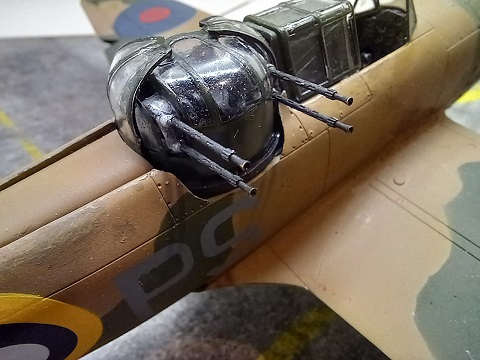
The Boulton Paul Defiant was unique among WWII RAF aircraft as the only single engine fighter with a gunner turret. The intent was for the Defiant to fly into a formation of bombers with the ability to fire in most directions. The expectation was that bombers flying directly from Germany would not have air escort because of the limited flying time for escort aircraft. The Defiant was very effective at its designed task, but it had one significant weakness; there was no forward-firing armament. As Luftwaffe units moved into occupied France, fighters were able to escort bomber formations all the way to the target. Escorting Bf 109s soon discovered and capitalized on the flaw, resulting in severe losses to the Defiant. At this point, the Defiant was switched to night time interception, where it was very successful until replaced by the Beaufighter and Mosquito.
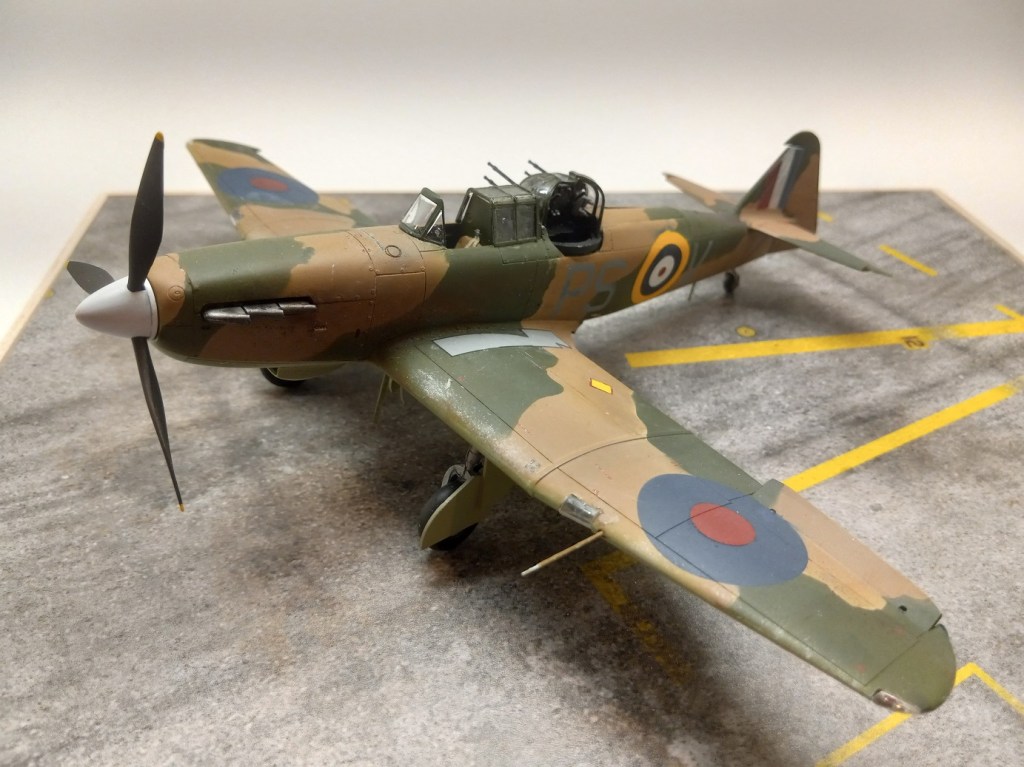
This is the Airfix 1/48th kit (A05128). I had to have it because of its distinctive appearance. An article in Model Airplane International indicated it was a straightforward build. An online search for walk-around photos suggests there’s only one museum aircraft in night-fighter configuration. Searching Scalemates.com, I tracked down accessories including the Yahu instrument panel, BarracudaCast wheels, Master brass gun barrels and pitot tube, the Montex Maxi Mask set and Eduard seat harness. Building the basic structure was fairly straightforward with one exception: getting the Yahu instrument panel to fit required a lot of trial and error, shaping and sanding the fuselage interior. But the result is worthwhile with beautiful detail. I deviated some from the instructions by installing the center lower wing section first, then adding the upper wings and finally the outer lower wings. I believe that minimized misalignment and the need for filling seams. Otherwise, the cockpit, fuselage and wings went together with little attention to seams. The turret is a separate small kit with seventeen parts that is assembled then set aside for later. Replacing the kit gun barrels with the Master brass ones was simple and the results are very effective.
The basic paint scheme was Mr. Color Dark Green (Kawasaki) for the interior, Tamiya Sky for the underside and Mr. Color Brown FS30219 and Vallejo Model Color Russian Green topside. Throughout the process, I had problems with paint peeling off, requiring touch-up many times before I was done. Besides the brass replacements, something else I tried for the first time was painting the insignia and markings instead of using decals. The Montex set includes masks for the interior and exterior of all canopy segments, but also has masks for the insignia and aircraft identifiers. Painting the wing roundels, the tricolor on the tail and aircraft identifier letters was fairly easy and I’m generally pleased. The four rings of the fuselage roundels didn’t line up perfectly, so I resorted to the decals. I discovered after the fact that I needed to paint the gray walkway first, then mask it for the rest of the paint scheme, so I wound up using the decal here as well.
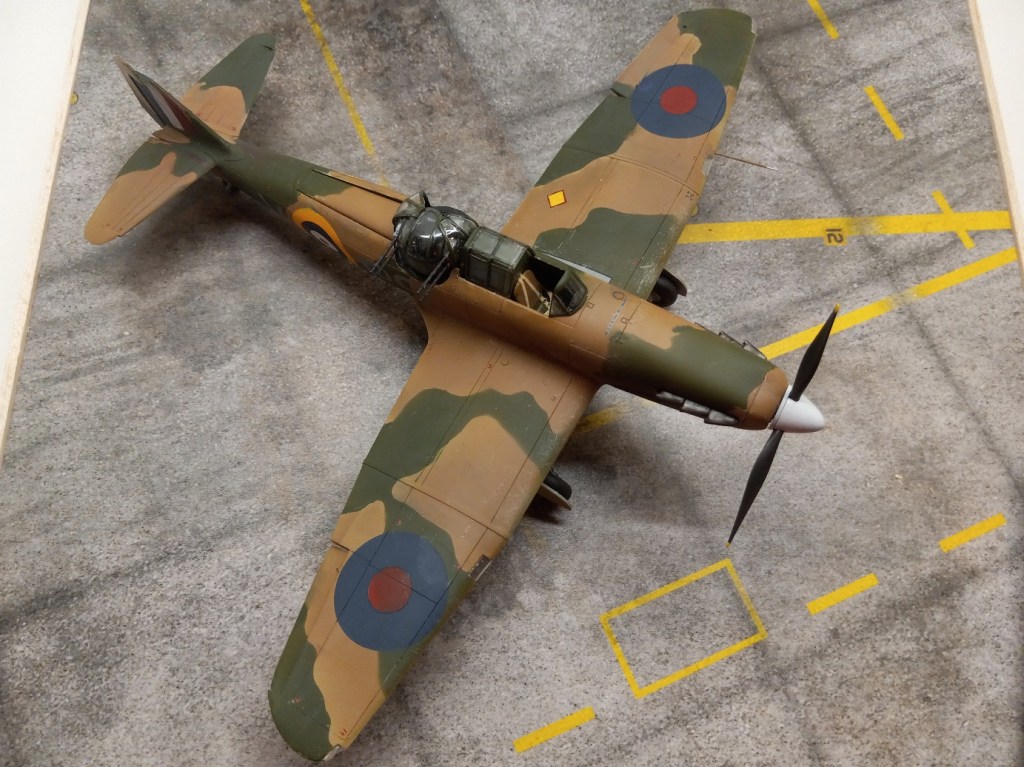
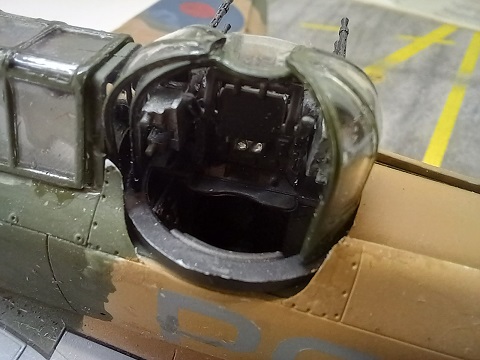
Once again, the canopy proved my biggest frustration. Masking the interior of each segment went pretty well, allowing me to paint the inside flat black and the outside the exterior colors, but all the manipulation left clear portions smudged. I don’t know if the “Looks Like Glass” doesn’t hold up that well, or if my old bottle of “Future” would have worked better. Also, I had hoped the turret would rotate once installed, but by the time you get the dome and the side panels in place, the turret could only be in one position.
I used a variety of weathering techniques. I started with my Daler Rowney paint markers with the finest tip to highlight panels with black and red earth inks. Using a tiny piece of sponge with aluminum paint, I added fine chips to the wings’ leading edges. Using different shades of very thin brown and gray acrylics, I sprayed along upper surfaces through a used dryer sheet for some color variation and then fine sprayed along upper and lower surfaces from the front for streaks. I used some oil pastels for streaks and stains and chalk pastels for exhaust streaks.
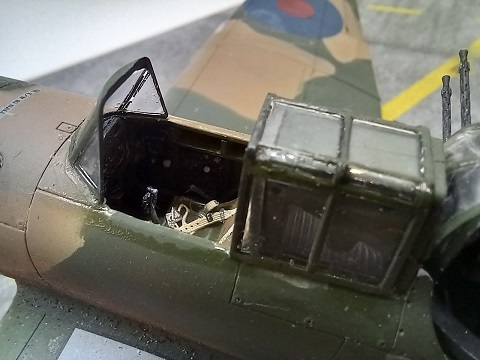
The Defiant was an interesting aircraft and the kit an interesting build. I think the supplements enhanced the detail. Learning to use the masks to paint insignia and identifiers went fairly well and I won’t be as intimidated by that the next time. But I need to figure out the problem with paint peeling and keeping clear parts pristine.

 Capital Area Modelers Society
Leave a comment